Sometimes the reason an adult finally considers orthodontic treatment is surprisingly specific. It is not severe crowding or a bite problem they can easily identify. It might simply be one tooth that sits slightly forward, overlaps its neighbour, rotates enough to look different in photographs, or has gradually shifted since earlier orthodontic treatment.
When the concern seems this small, it is natural to wonder whether Invisalign can simply correct that tooth. Sometimes treatment can remain relatively limited, but the answer depends on what placed the tooth in that position in the first place. Our job is to start with the change you want to see and then determine what is happening beneath that very visible concern.
Invisalign In Surrey For Adults: Why Is That Tooth Crooked?
The same visual problem can have very different causes. A front tooth may have erupted into an area where there was not quite enough room. Another may have rotated as crowding developed. A tooth that was once straight may have shifted years after previous orthodontic treatment. There are also cases where the tooth itself is not dramatically displaced, but its shape or relationship with the teeth beside it makes the difference look much more obvious.
That distinction matters because orthodontic treatment addresses position, not simply appearance. During an assessment, we look at the dental arches, the relationship between the upper and lower teeth, the available space and the position of the tooth within that larger arrangement. Photographs, digital scans and appropriate imaging may also help us understand what cannot be determined by looking at the smile alone.
We recently saw an adult patient who was bothered by a rotated front tooth. It had become the first thing the patient noticed in photographs, so the expectation was that Invisalign treatment would simply rotate it back into line. Our assessment showed that the tooth did not have sufficient room to rotate properly in its existing position. Before addressing the rotation itself, the treatment plan had to create the conditions that would allow that movement to occur.
This is why we encourage patients to be very specific about what they want to change without feeling that they need to diagnose the problem themselves. Point to the tooth. Show us the photograph where you notice it most. Tell us whether it has always looked that way or whether you have watched it change. That gives us a clear cosmetic goal while the examination gives us the clinical information needed to understand its cause.
How Do We Actually Move One Tooth?
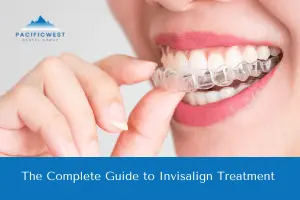
Once we know why the tooth is out of position, the next question is mechanical: what has to happen to get it where we want it to go? Invisalign uses a planned sequence of aligners to apply controlled forces to teeth. A tooth that needs to rotate, move backward or come into alignment may require other teeth to participate in the process so that the intended movement can occur predictably.
Imagine a lateral incisor sitting slightly behind the other front teeth. It may appear that the obvious solution is simply to bring it forward. If the intended destination is already occupied, however, the aligners need a plan for creating the necessary room. That might mean distributing small movements among other teeth rather than asking the lateral incisor to somehow squeeze into a space that does not yet exist.
This is also where attachments can enter the treatment plan. These small tooth coloured shapes are bonded to selected teeth when we need the aligner to engage them in a particular way. An adult who expected an extremely simple treatment can initially be surprised to see attachments included in the simulation, especially if the original complaint involved only one tooth. Their presence does not necessarily mean the case is extensive. They are tools that can help us control specific movements.
The digital treatment plan can therefore look more active than the patient’s original request. Several teeth may move slightly even though the visible goal remains correcting one particular tooth. Those movements have specific jobs within the sequence. We are not expanding the treatment simply because other teeth can be moved. We are planning the mechanics required to reach the agreed goal.
What Determines The Scope Of Treatment?
There is an important difference between having a small cosmetic concern and having a clinically simple orthodontic case. Sometimes those two things coincide, and sometimes they do not. Before we can estimate the scope of treatment, we need to look beyond how noticeable the crooked tooth appears.
Several factors can change what treatment involves:
- The type of movement required: Moving a tooth a short distance does not necessarily make the movement simple. Rotation, angulation and other positional changes present different mechanical requirements, so the direction of movement can matter as much as the distance.
- The condition of the teeth and supporting tissues: Adult orthodontic planning includes the health of the teeth, gums and supporting structures. Existing dental work or other clinical findings can influence how we approach movement and whether another dental issue should be addressed first.
- The patient’s treatment goal: One adult may be primarily interested in improving a specific feature of the smile, while another may want to address additional orthodontic concerns discovered during the examination. Understanding that distinction helps us discuss what is necessary and what may be optional.
- The predictability of the proposed movement: A digital plan can show where we want a tooth to go, but treatment planning also requires us to consider how realistically that movement can be achieved with clear aligners. If a particular movement needs additional control, we factor that into the plan from the beginning.
- How the proposed change fits the existing dental work: Crowns, bridges, implants or other restorations can affect orthodontic planning. An implant, for example, does not move orthodontically like a natural tooth, so its position can influence what is possible around it.
These are some of the reasons we cannot estimate treatment simply by counting crooked teeth. Two adults may each come in pointing to one front tooth, yet one may be suited to a relatively focused correction while the other requires a broader plan. The difference comes from the clinical circumstances behind the complaint, not from how minor or major the smile looks at first glance.
When The Tooth Is Not The Only Reason It Looks Different
There is another possibility that becomes particularly important when the patient’s concern is highly specific. Sometimes moving the tooth can improve its position but cannot completely change the feature the patient dislikes, because position is only one part of what they are seeing.
Suppose one front tooth appears noticeably uneven beside the other. Part of that difference may come from rotation, but the teeth may also have different shapes, edge lengths or proportions. Gum levels can influence visual symmetry too. Moving the tooth into a better position can address the orthodontic component, but Invisalign cannot make two naturally different teeth identical in size or reshape a tooth simply by moving it.
We have had patients come to us expecting a particular tooth to look completely different once it was straight. During the consultation, showing them exactly which part of the concern came from position and which part came from tooth anatomy changed the conversation. Instead of promising that orthodontics would solve something it could not, we could establish a realistic treatment goal from the beginning.
This is particularly useful for adults pursuing a small cosmetic improvement. If you are undertaking treatment primarily because of one detail you have noticed for years, we want to understand what success means to you before treatment begins. That way, the decision to proceed is based on what Invisalign can realistically change rather than on the assumption that straightening automatically corrects every visual difference.
What If You Already Had Braces?
Many adults who ask us about one troublesome tooth are not new to orthodontics at all. They remember having straight teeth when their braces came off years earlier, but eventually noticed one tooth beginning to shift. Sometimes they stopped wearing a removable retainer long ago. In other cases, they continued using one for years until it stopped fitting comfortably or became damaged.
This history gives us useful information. If you still have an old retainer, bring it with you even if you can no longer wear it. It can be helpful to know when you last wore it comfortably, approximately when you began noticing the change and whether the movement has continued. Old photographs can also provide context when you are unsure how much the tooth has actually shifted.
We saw an adult patient who had completed orthodontic treatment as a teenager and came back to orthodontics years later because a lower front tooth had become increasingly noticeable. The patient initially assumed that going back into treatment meant repeating the entire experience from adolescence. After evaluating the current tooth positions and bite, we were able to discuss the situation based on how the mouth looked now rather than automatically recreating the previous treatment plan. Previous braces were part of the history, but they did not dictate the new plan.
Retention also becomes especially relevant in cases like this because the patient has already experienced movement after treatment. Once active Invisalign treatment is complete, we provide instructions for maintaining the corrected positions. Rather than thinking of the retainer as an afterthought that appears when the last aligner is finished, it helps to see retention as a planned phase of orthodontic care from the outset.
Invisalign In Surrey For Adults
You do not need to arrive at an orthodontic consultation asking for a complete smile transformation. If there is one tooth you have been hiding in photographs, noticing in the mirror or thinking about correcting for years, start there. We can determine what is causing the concern and show you what would actually be involved in changing it.
At PacificWest Dental Group, we can assess whether Invisalign is appropriate for the result you have in mind and build the conversation around your actual priorities. Bring your questions, old retainers or even the photos where that tooth bothers you most. We will take it from there. Click here to get in touch or, if you prefer, call us on 604-558-0993.

Hello! I’m Dr. Kevin Lee, a certified orthodontic specialist at PacificWest Dental Group, proudly serving the vibrant communities of Vancouver and Surrey. My journey into orthodontics began back in high school. As a teenager wearing braces, I became fascinated by the intricate blend of art, engineering, and biology that defines this field. This early experience ignited a passion that has guided me throughout my career.
I pursued my academic journey at the University of British Columbia (UBC), where I earned a Bachelor of Science in Biochemistry in 2006, followed by a Doctor of Dental Medicine in 2011. After a year-long residency at Montefiore Medical Center in New York, I returned to UBC to complete a combined Master of Science in Craniofacial Biology and a Diploma in Orthodontics in 2015. That same year, I achieved certification from both the Royal College of Dentists of Canada and the American Board of Orthodontics.
With over a decade of clinical experience, I remain deeply committed to staying at the forefront of orthodontic advancements. At PacificWest Dental Group, we prioritize personalized treatment plans tailored to each patient’s unique needs, ensuring comfort and care every step of the way. Our goal is to help you achieve the smile you’ve always dreamed of in a welcoming and supportive environment.
Outside the clinic, I enjoy engaging with our community and staying active. Whether it’s through local events or outdoor activities, I believe in building strong relationships both inside and outside the office. I look forward to meeting you and working together to create a beautiful, confident smile.
Services we provide:
-Invisalign
-Braces
-Lingual Braces
-Digital treatment planning
-TMJ and headpain treatment
-Laser Therapy
-Sleep Apnea Oral Appliance
-Dysport Cosmetic Injectables