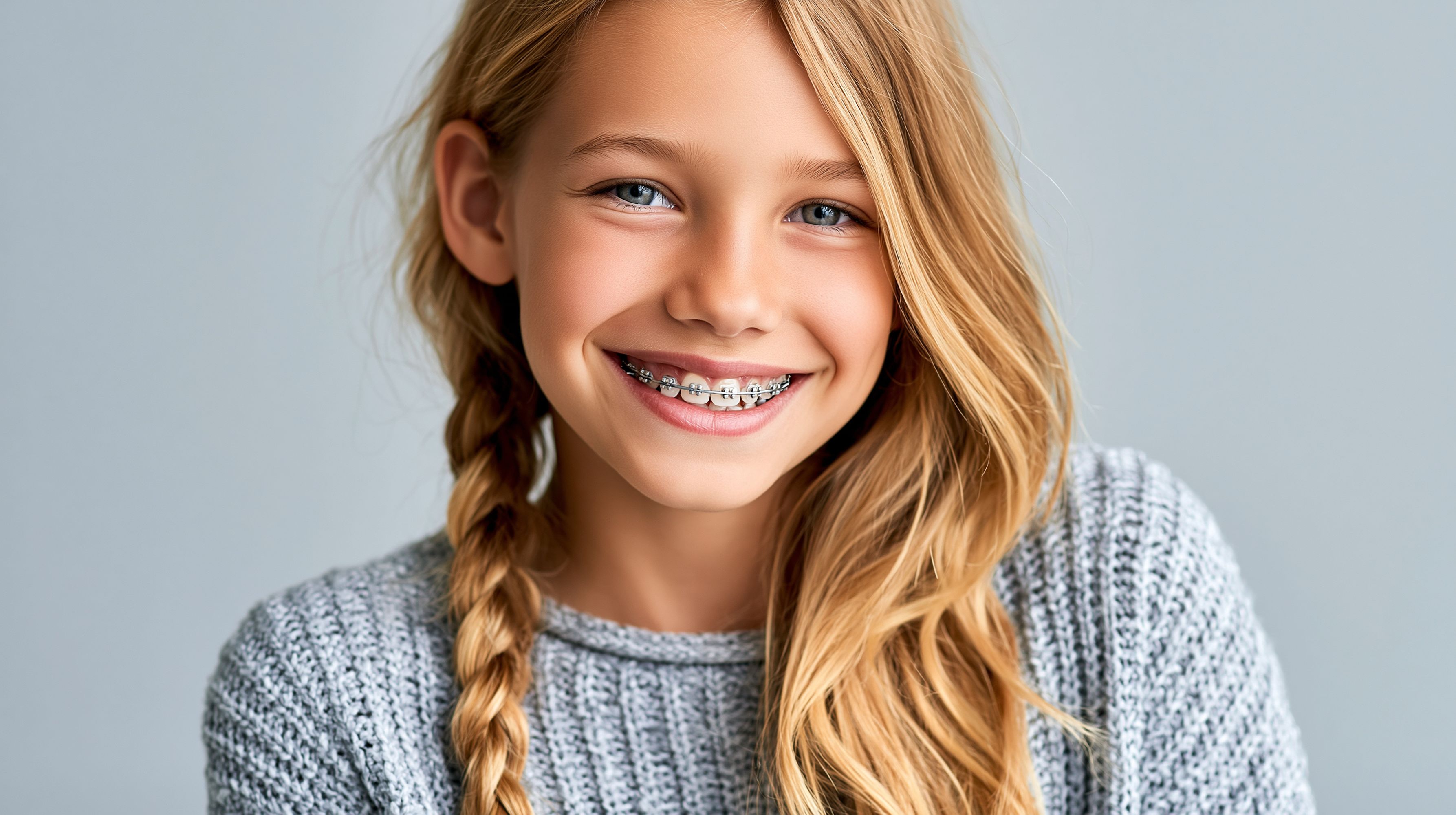
Parents often associate braces with a very specific milestone: all the baby teeth fall out, the adult teeth come in, and orthodontic treatment begins. Real dental development is rarely that tidy. For several years, children typically have a mixture of baby and permanent teeth, and some orthodontic concerns become visible during this transition.
That does not mean every child with crooked teeth should start braces early. Baby teeth are one piece of a much larger developmental picture that includes eruption, available space, jaw growth, and the way the upper and lower teeth meet. When we evaluate a child during this stage, we are trying to understand that picture and determine whether there is something useful to accomplish before the permanent dentition is complete.
Braces In Vancouver For Kids And The Role Of Baby Teeth
Baby teeth are temporary, but that does not make them irrelevant to orthodontic planning. They occupy positions within the dental arches while permanent teeth develop and erupt around them. Which baby teeth remain, which have already fallen out, and where the permanent teeth are appearing can give us useful information about the child’s stage of dental development.
This is one reason two children of exactly the same age can receive different orthodontic recommendations. One may have already lost most baby teeth and have many permanent teeth in place. Another may still be much earlier in the transition. Their birthdays may be identical, but their mouths are giving us different information.
We saw this with two young patients of similar ages who came in within a relatively short period. One had several permanent teeth already erupting and a bite problem that was becoming easier to define as the dentition developed. The other still had considerably more dental development ahead. Although the parents were asking similar questions about braces, there was no reason to force both children onto the same timetable.
That is why we prefer to talk about developmental stage rather than a universal age for braces. Knowing that a child still has baby teeth does not end the conversation. It tells us where to begin looking.
What We Can Learn Before All The Permanent Teeth Arrive
Mixed dentition gives us an opportunity to observe the transition itself. We can see how permanent teeth are entering the arches, whether the sequence appears appropriate, how much room is available, and whether the bite is developing in an expected way. We are not trying to predict every detail of the finished adult smile. We are looking for patterns that may influence future treatment.
Eruption is particularly useful to watch. Suppose a permanent tooth has appeared on one side while the corresponding baby tooth on the other side remains for considerably longer. That difference does not automatically indicate a problem, because children do not develop according to perfectly symmetrical calendars. It does, however, give us something specific to investigate rather than simply assuming the remaining tooth will eventually sort itself out.
The path of an erupting tooth can provide information too. Parents sometimes notice a new tooth appearing noticeably inside or outside the line of the other teeth. We can assess whether that position reflects temporary crowding during an awkward developmental stage or whether the eruption pattern suggests a more significant space or positioning issue. When necessary, appropriate imaging can help us understand where unerupted permanent teeth are located and how they are developing.
Parents do not need to monitor this like orthodontists at home. More useful observations are simple ones: one side developing very differently from the other, a baby tooth remaining much longer than expected, a permanent tooth appearing in an unusual place, or a noticeable change in how the child closes the mouth. Those are useful details to bring to us because they tell us what the family has been seeing between dental visits.
When Treatment Before All Baby Teeth Are Gone Has A Specific Purpose
When braces or another orthodontic appliance are considered during mixed dentition, there should be a defined problem we are trying to address. The objective is not to make every visible tooth perfectly straight as quickly as possible. At this stage, timing should serve a clinical purpose.
Some situations that may lead us to consider earlier orthodontic treatment include:
- A crossbite that changes the way the child closes the jaw. We pay particular attention when a child needs to shift the jaw to find a comfortable biting position. This is different from being concerned simply because a front tooth looks crooked.
- A developing space problem. Permanent teeth need adequate room to erupt into the dental arches. When space is limited, we assess where the shortage is occurring and how the remaining teeth are developing before deciding whether intervention is appropriate.
- A permanent tooth following an unusual eruption path. The important question is not simply whether a tooth looks late. We want to understand its position and whether another tooth or an anatomical limitation is affecting where it can erupt.
- Prominent front teeth with particular functional or injury concerns. Some children have front teeth positioned far enough forward that their exposure becomes relevant to the orthodontic assessment. We consider the whole bite and stage of growth rather than treating prominence as a cosmetic issue alone.
- A jaw relationship where growth matters to planning. Certain orthodontic problems involve the relationship between the jaws as well as the positions of individual teeth. In selected cases, the child’s growth stage can influence when we want to address the problem.
These are very different clinical situations, which is precisely why “my child still has baby teeth” cannot tell us what treatment will look like. The problem we identify determines the objective. Only after defining that objective can we decide whether braces, another orthodontic approach, or no immediate intervention makes sense.
Why Early Braces May Be Only One Stage Of Treatment
Parents can understandably assume that if braces begin early, the goal is to complete all orthodontic treatment before adolescence. That is not always how treatment during mixed dentition works. Sometimes an earlier phase has a deliberately limited objective, and final alignment is considered later after additional permanent teeth have erupted.
For example, we treated a child whose earlier orthodontic care focused on the relationship between the upper and lower teeth. Several permanent teeth had not yet appeared, so trying to create a completely finished adult result at that point would not have made sense. We addressed the issue that was relevant during that developmental stage and then allowed dental development to continue.
When more permanent teeth erupted, we had a different set of decisions to make. Their final positions could not have been fully established during the earlier phase because those teeth were not yet in the mouth. A later phase could therefore focus on alignment and finishing in a way the first phase was never intended to accomplish.
This distinction helps families understand what they are agreeing to before treatment begins. If we recommend an early phase, we should be able to explain what we want it to accomplish and what questions will remain for later. It is better to view each phase according to its own purpose than to assume that starting young necessarily means finishing everything young.
What Happens When We Decide Your Child Should Wait?
Waiting can be an active orthodontic plan. Instead of beginning treatment immediately, we can identify the developmental change that will give us better information and reassess when it occurs. That might mean waiting for particular permanent teeth to erupt, following the loss of specific baby teeth, or observing a developing bite over time.
We had a young patient whose parents were concerned because the newly erupted front teeth looked crowded and angled. They expected us to recommend braces based on how dramatic the change looked compared with the child’s previous baby teeth. Our examination did not identify a reason to intervene at that stage, so we monitored development while additional permanent teeth appeared.
That extra development gave us information we simply did not have at the first visit. Instead of beginning treatment because the smile temporarily looked crowded, we were eventually able to plan around a much clearer picture of the permanent teeth. In that case, time was not wasted. It was part of gathering the information needed for better timing.
This also gives parents something more useful than “come back someday.” If we choose observation, we can explain what we are watching and why. Families then know that the absence of braces does not mean the orthodontic question has been forgotten. It means there is a reason to let the next stage of development happen before making another decision.
Braces In Vancouver For Kids: Bring Us The Question Early
You do not need to determine at home whether the remaining baby teeth mean your child is too young for orthodontic care. If something about the eruption pattern, tooth position, or bite has caught your attention, that is enough reason to ask about it. An assessment can give you a much more useful answer than waiting for an arbitrary milestone.
At PacificWest Dental Group, we can evaluate your child’s current stage of dental development and tell you what, if anything, should happen next. If you are considering braces in Vancouver for kids, contact us to arrange an orthodontic assessment by clicking here. If you prefer talking on the phone, please feel free to reach us on 604-558-0993.

Hello! I’m Dr. Kevin Lee, a certified orthodontic specialist at PacificWest Dental Group, proudly serving the vibrant communities of Vancouver and Surrey. My journey into orthodontics began back in high school. As a teenager wearing braces, I became fascinated by the intricate blend of art, engineering, and biology that defines this field. This early experience ignited a passion that has guided me throughout my career.
I pursued my academic journey at the University of British Columbia (UBC), where I earned a Bachelor of Science in Biochemistry in 2006, followed by a Doctor of Dental Medicine in 2011. After a year-long residency at Montefiore Medical Center in New York, I returned to UBC to complete a combined Master of Science in Craniofacial Biology and a Diploma in Orthodontics in 2015. That same year, I achieved certification from both the Royal College of Dentists of Canada and the American Board of Orthodontics.
With over a decade of clinical experience, I remain deeply committed to staying at the forefront of orthodontic advancements. At PacificWest Dental Group, we prioritize personalized treatment plans tailored to each patient’s unique needs, ensuring comfort and care every step of the way. Our goal is to help you achieve the smile you’ve always dreamed of in a welcoming and supportive environment.
Outside the clinic, I enjoy engaging with our community and staying active. Whether it’s through local events or outdoor activities, I believe in building strong relationships both inside and outside the office. I look forward to meeting you and working together to create a beautiful, confident smile.
Services we provide:
-Invisalign
-Braces
-Lingual Braces
-Digital treatment planning
-TMJ and headpain treatment
-Laser Therapy
-Sleep Apnea Oral Appliance
-Dysport Cosmetic Injectables